
Mary Shelley's Frankenstein
Usurper of birth

We each possess the potential to birth someone/something into this world, whether it be a child or an idea, and Mary Shelley’s Frankenstein exposes us to what happens when our creative efforts veer toward parental neglect. When we abandon our children or abdicate our communal responsibility as caretakers of creation, we do so at the peril of humanity.
And at the foundational cradle of that humanity is the woman, who all too plainly in Shelley’s vision—doubly so visionary in her not-yet-twenty years of age—gets killed (in her role as nursing nurturer to a child), framed (in the society of Potemkin men as wielders and arbiters of guilt devoid of justice), and murdered (at the precipice of marriage).
And the man whose egoistic flippancy as usurper of childbirth clearly delineates how one being’s arrogance is another’s helplessness.
I know that giving birth meant leaving Earth to get my child.
(To say otherwise is perhaps a coping mechanism.)
Shelley showed us the afterbirth.
She knew that bringing life to Earth meant taking responsibility for it.
(To say otherwise is perhaps a coping mechanism.)
That to create life without love is to sentence life to death.
That to bring into existence artificial technology, innovation, and so on in an isolationist mode of thinking (which modernity habitually adopts as its modus operandi) without the bedrock of collective caretaking and parental nurturing is to cast the die against life.
“I am malicious because I am miserable,” the grieving Creature states.
And the Promethean creator lays silent, guiltily so.
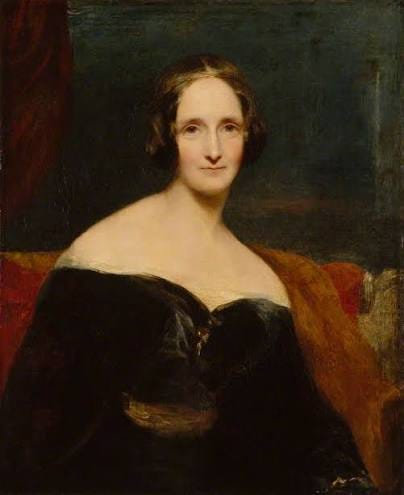
The girl who learned to read by tracing the letters on her mother's tombstone; the teen who wrote a masterpiece while grieving the loss of her infant; the woman who saw what sometimes we wrapped in the ego of modernity fail to comprehend. Mary Shelley opened for us the door to empathy and grieving, for not mistaking a misunderstood worldly creature for that of an otherworldly monster. She birthed and shouldered the responsibility of the storyteller, wordsmith, and steward of the threshold between life and death called grief.
Lest we forget the etymology of the term creature, Frankenstein is still here to remind us of our social and collective responsibility, as does Robin Wall Killemer that
“It is worth pointing out that the way we now use the word creature ignores a richer etymology. Today, we refer to birds and bees as creatures. Living things are creatures by virtue of their living-ness. When we call something a creature today, we rarely think in terms of something that has been created, and thus we erase the idea of a creator behind the creature. We have likewise lost the social connotation of the term creature, for creatures are made not just biologically (or magically) but also socially.”
Happy reading, my lovely ones.
—A
This is pure poetry, Ani! I have always resonated the most with seeing Frankenstein through the lens of the absence of the MOTHER, what that looks like and oh my, it is a horrific monstrosity that she presents us with in Frankenstein's techno birthing and abandonment of the Creature. Wonderful post.